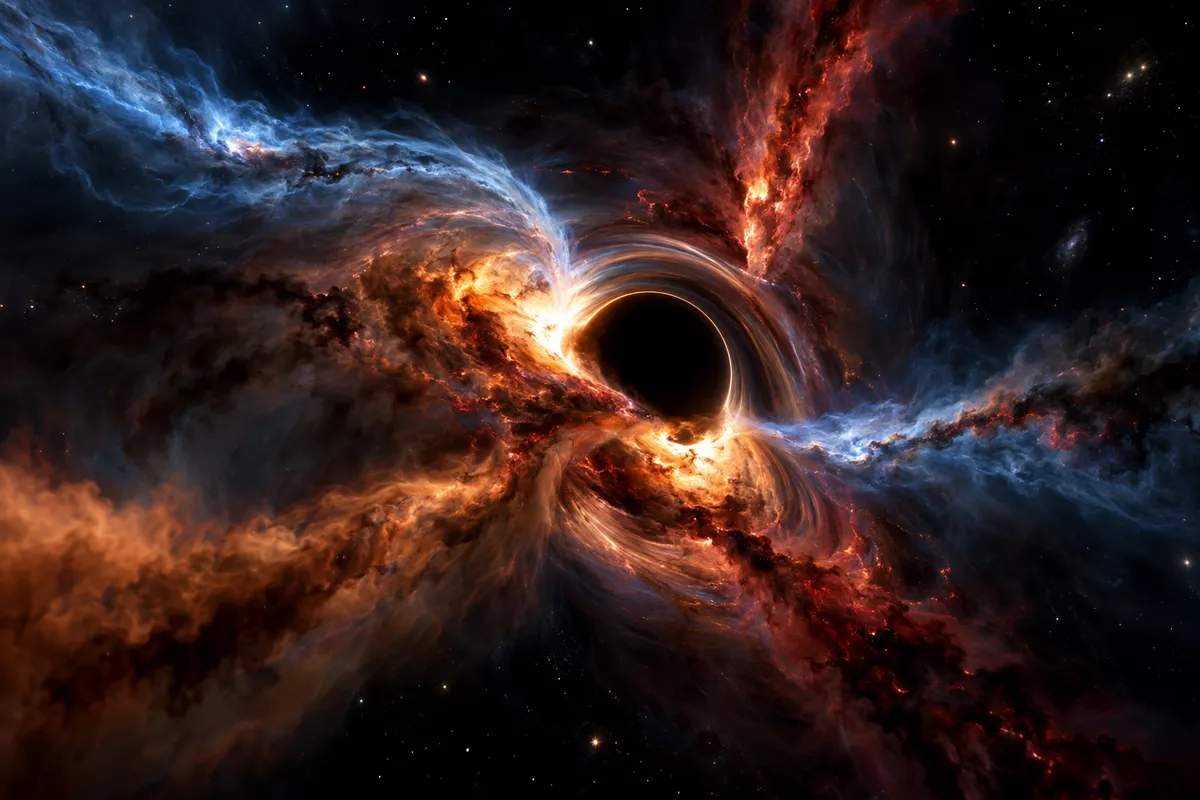
When the universe was less than 700 million years old, the quasar J0313-1806 was already powered by a supermassive black hole of about 3 billion times the mass of the sun, per Phys. That is a baffling amount of weight for so little time. By the end of this article, you'll understand why it's a puzzle, and how a new study says disorder in the feeding process could be the answer.
The work, reported by Phys and published in Astronomy & Astrophysics, argues that early black holes may have grown fast enough through "chaotic accretion." In that picture, ordinary stellar-mass seeds could have been enough to build the earliest known giants.
The speed limit problem
Black holes grow by pulling in gas. But gas that falls in heats up and glows, and that light pushes back on incoming material. This sets a natural ceiling on how fast a black hole can feed, usually called the Eddington limit.
That creates a timing problem. If you start with a black hole born from a dead star and let it feed at a steady, limited pace, it's hard to reach billions of solar masses in under 700 million years. Astronomers have generally had two escape routes:
- Heavy seeds: black holes that start out already very massive, which would be a rare route.
- Super-Eddington growth: stretches of feeding that break the speed limit, which would have to be sustained over a long time.
The new model proposes a third option, which skips both of those requirements.
What "chaotic accretion" means
Gas doesn't necessarily arrive at a black hole in a neat, consistent stream. In the chaotic picture, the gas forms disks whose orientations are random from one feeding episode to the next.
That randomness matters because of spin. A disk that always spins the same way as the black hole would spin it up. Disks tilted at random angles can push the spin in different directions, so the black hole's spin stays low, according to the study as described by Phys.
Why low spin means faster growth
This is the counterintuitive part. A low-spin black hole is less efficient at turning infalling matter into radiation. Less of the gas's energy leaves as light, so more of the matter ends up added to the black hole itself.
There's a second benefit that follows from the same logic, and it's my reading of the model rather than a claim from the report: less light means less outward push on the gas, so the usual brake on feeding is gentler. Being a messy, inefficient eater, in other words, works in the black hole's favor.
The result, per the study, is that ordinary stellar-mass seeds could reach the sizes seen in the earliest giants without rare heavy seeds or long-term super-Eddington feeding.
Why the question is hot right now
The debate has intensified because JWST has been revealing surprisingly massive black holes in the early universe, along with the "little red dot" galaxies that astronomers are still working to understand. Each new discovery makes the growth-speed problem harder to ignore. A model that explains the giants with fewer special conditions is attractive for that reason.
Attractive is not the same as proven, though. This is a model, and it makes predictions that can be checked.
How the idea could be tested
If chaotic feeding is right, early supermassive black holes should be slow spinners. Upcoming and future facilities, including Euclid, Roman, and NewAthena, could help test that, per the report. Finding that these black holes are slow-spinning products of chaotic feeding would support the model. Evidence pointing the other way would count against it.
The three explanations side by side
- Heavy seeds: start big, so less growth is needed.
- Speed-limit-breaking growth: feed faster than the usual ceiling, for a long time.
- Productive chaos: start small, feed in random directions, stay slow-spinning, and waste less mass as light.
These are not necessarily exclusive, and the universe may have used more than one. But the third has the appeal of needing the fewest exceptions.
The takeaway
Next time you read about a record-breaking early black hole, ask one question: how did it eat, and how much of its meal did it turn into light? That's where the new research says the answer may be hiding.