Rocks have been pulling carbon dioxide out of the air for millions of years. They're just slow about it. By the end of this article, you'll understand how researchers want to speed that process up by spreading crushed rock on farm fields, why it's attracting attention, and which questions remain open.
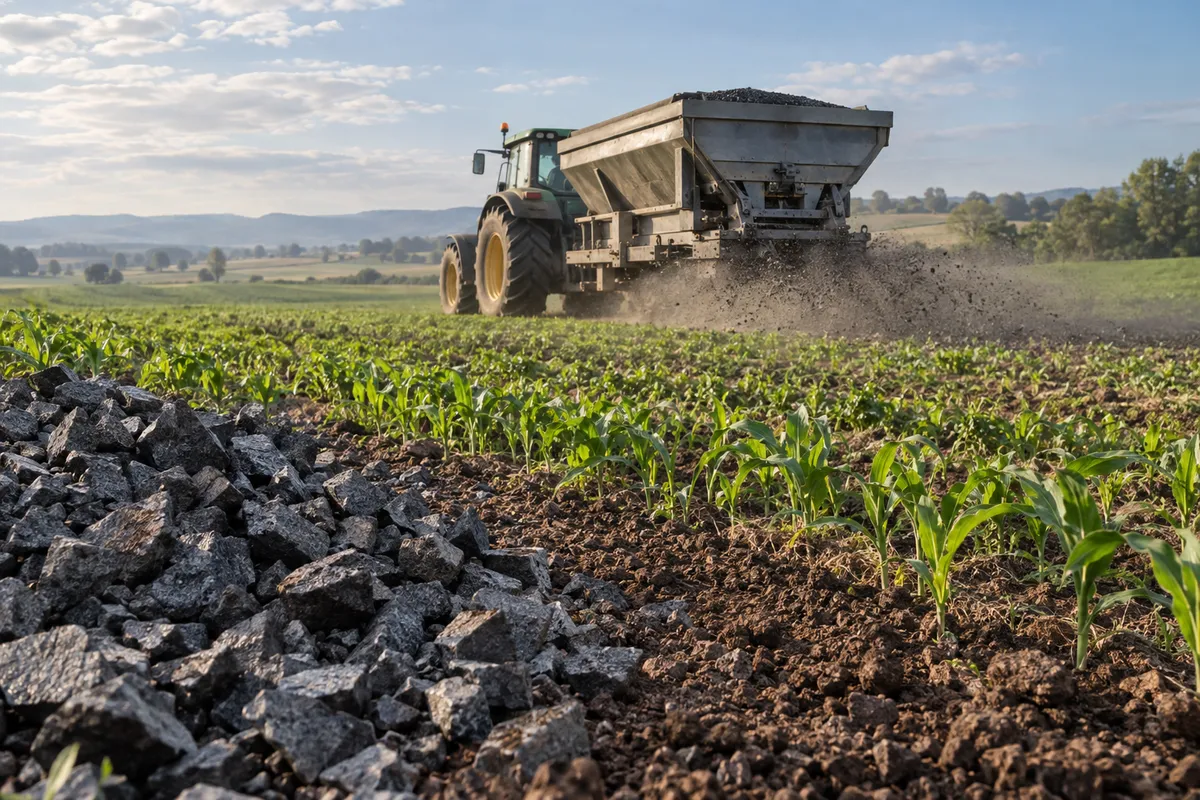
Per Phys, researchers at UC Davis are testing a method called enhanced rock weathering: spreading crushed basalt on agricultural land to accelerate natural carbon capture.
What enhanced rock weathering actually is
Weathering is the slow breakdown of rock by rain, air, and water. As part of that natural process, certain minerals react with carbon dioxide dissolved in water. The result is bicarbonate, a form of carbon that can be carried away in water instead of lingering in the atmosphere as CO₂.
Enhanced rock weathering takes that geological process and gives it a push. Crushing basalt creates far more surface area for those reactions to happen on. Spread it across cropland, and the farm becomes the site where the chemistry plays out.
In plain terms: you're taking a very slow natural reaction and engineering it to work on a human timescale.
Why farmland is the target
Farms already involve spreading materials on soil, so the logistics are familiar. Phys reports that the approach could scale across farmland, which is a big part of its appeal.
There's a possible second payoff. The UC Davis work suggests the method could potentially improve soil nutrients and crop health while it removes CO₂. That would make it more than a climate project for a farmer; it could be part of how the land is managed. Keep the word "potentially" in mind, though. That benefit still needs to be demonstrated.
Why people care about carbon removal now
Carbon dioxide levels are far above preindustrial levels, according to the report. Clean energy cuts new emissions, but it doesn't remove what's already in the air. That older, accumulated CO₂ is often called "legacy" CO₂, and removing it requires a different set of tools.
Big companies are paying attention. Phys notes that Microsoft and Google are investing heavily in carbon removal. Enhanced rock weathering is gaining interest because it might offer a way to address legacy CO₂ at a large scale.
What scientists still need to figure out
This is where realism matters. The researchers' argument is that more field science is needed to prove where and how the method works best. Three open areas stand out in the report's framing:
Measurement
The chemistry happens in soil and water, spread across big fields. Proving how much CO₂ was actually removed is hard, and any carbon-removal claim depends on trustworthy numbers.
Scale
A promising result on a test plot doesn't automatically translate to millions of acres. Scaling up raises practical questions that only wider testing can answer.
Soil conditions
Soils differ. The method may work well in some places and poorly in others, which is why researchers say they need to learn where and how it performs best.
How to think about it as a reader
It's easy to hear "crushed rock fixes climate" and either get excited or roll your eyes. A more useful stance sits in the middle. The underlying chemistry is natural and well established. What's new is deploying it deliberately, on working farms, and verifying the results.
If you see a company selling carbon credits from this method, a few questions are fair to ask:
- How do they measure the CO₂ removed?
- Has the approach been tested in conditions like the ones where it's being used?
- Is there field data behind the claims, not just lab expectations?
Those questions mirror the gaps the UC Davis researchers say need filling.
The takeaway
Enhanced rock weathering is a promising idea with real chemistry behind it, but its value will be settled in fields, not headlines. When you hear about a carbon-removal project, look for the field data first.