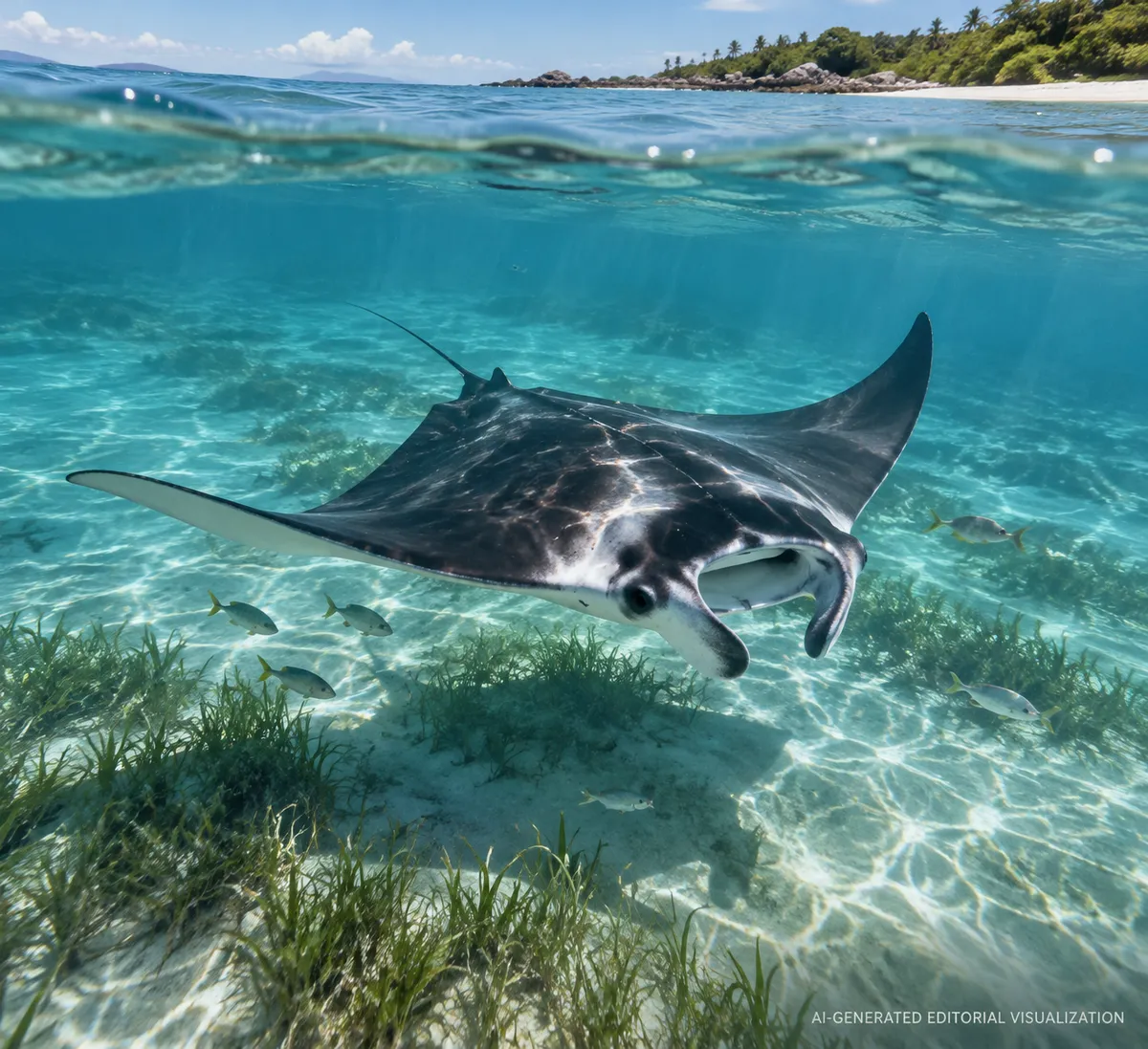
Giant manta rays can grow up to 30 feet long and 4,409 pounds. They don't start that way. A new study in Frontiers in Fish Science, reported by Popular Science, shows how baby mantas in Central America survive while they're still small: they stay close to shore, in shallow water where predators are less likely to hunt. By the end of this piece, you'll know where young mantas spend their early years, how researchers figured it out, and why that matters for protecting the species.
Small bodies, big predators
Giant manta ray babies, called pups, can't rely on size for protection. Per Popular Science, the open ocean around Central America holds orcas and numerous sharks, and a young manta is a manageable meal for them.
Their solution is to stay near the coast. The researchers found that young mantas, defined as those with a body of about 10 feet or less, stuck to shallow coastal refuges. These areas don't overlap with their predators' hunting grounds.
Adults are a different story. Study co-author Jeffry Madrigal-Mesén, project leader of Mantas Costa Rica, put it this way: "Mature adults can rely on their massive body size and their ability to dive deep to evade threats. But juveniles don't have that luxury."
What the shallows offer
Safety isn't the only draw. According to the report, the shallow refuges give young mantas:
- Plenty of food to fuel growth
- Places to hide
- Cleaning services from reefs
That last one is a nice detail. Reefs act as a kind of grooming service for the rays, and the study describes these nearshore cleaning stations as more than hygiene spots. Madrigal-Mesén said they also act as "primary social hubs where courtship and reproductive interactions take place."
How researchers pieced it together
Tracking a fish that roams the ocean is hard, so the team combined three methods at five locations between 2018 and 2025:
- Acoustic telemetry: underwater sound pulses monitor fish movements. This tracked 59 individual rays.
- Satellite telemetry: transmitters track large-scale movements from a distance. This covered 12 individuals.
- Photo identification: images help recognize individual manta rays.
The result was a dataset of more than 12,000 detections. Madrigal-Mesén said, "If we hadn't used all three technologies together, we simply wouldn't have been able to piece this puzzle together."
Juveniles stay put, and they come back
The juveniles weren't just hanging around the coast in general. Madrigal-Mesén said the team sees the same individuals more often than once a year, and that some were recently sighted again at the exact same tagging location. "It is always a joy to see them again," he said. "They have truly become a part of the family."
That loyalty seems to carry into adulthood. One manta nicknamed Mickey Mouse, for a spot pattern on his belly, was unusually approachable and let the team tag him several times over multiple years. In 2020 he logged 462 acoustic detections at a coastal hub called El Secreto. He returned to the same shelf in 2023 and stayed 38 days.
Adults leave the nursery
Nine mature mantas in the study went on expansive migrations along the continental shelf break. Madrigal-Mesén said, "Giant manta rays in Central America undergo a dramatic shift in space use as they mature." Juveniles stayed strictly in shallow nearshore waters, while most tracked adults made long-distance migrations across national borders.
Per the study, returning to a predictable coastal spot lets adults take care of social and cleaning needs before heading off on large regional journeys.
Where the danger shifts
Leaving the shallows swaps one set of risks for another. Coastal areas are often legally protected marine reserves. The open ocean generally isn't. Per Popular Science, adult mantas there are exposed to industrial fisheries and vessel strikes.
The team says this shows marine protected areas alone aren't enough for such a mobile species. Their proposed fix is multi-national "conservation swimways" that connect the juvenile coastal refuges with adult migratory corridors. The idea, in plain terms, is to protect the whole route rather than just the endpoints.
It's worth saying what the study doesn't claim: the swimways are a proposal from the researchers, not an established program. Still, the logic is easy to follow. A manta that grows up safely in a reserve can still be lost once it crosses an unprotected boundary.
What you can take from this
The study is a reminder that animals don't live in one place. A species can need very different habitats at different life stages, and protecting one of them isn't enough. Madrigal-Mesén said the team hopes the work "sparks fresh enthusiasm" and draws more collaborators to future research on the species.
If you want to act on it, look for conservation efforts that protect migration routes and not just single reserves, and support the groups doing the tracking work. The nursery matters, but so does the road out of it.