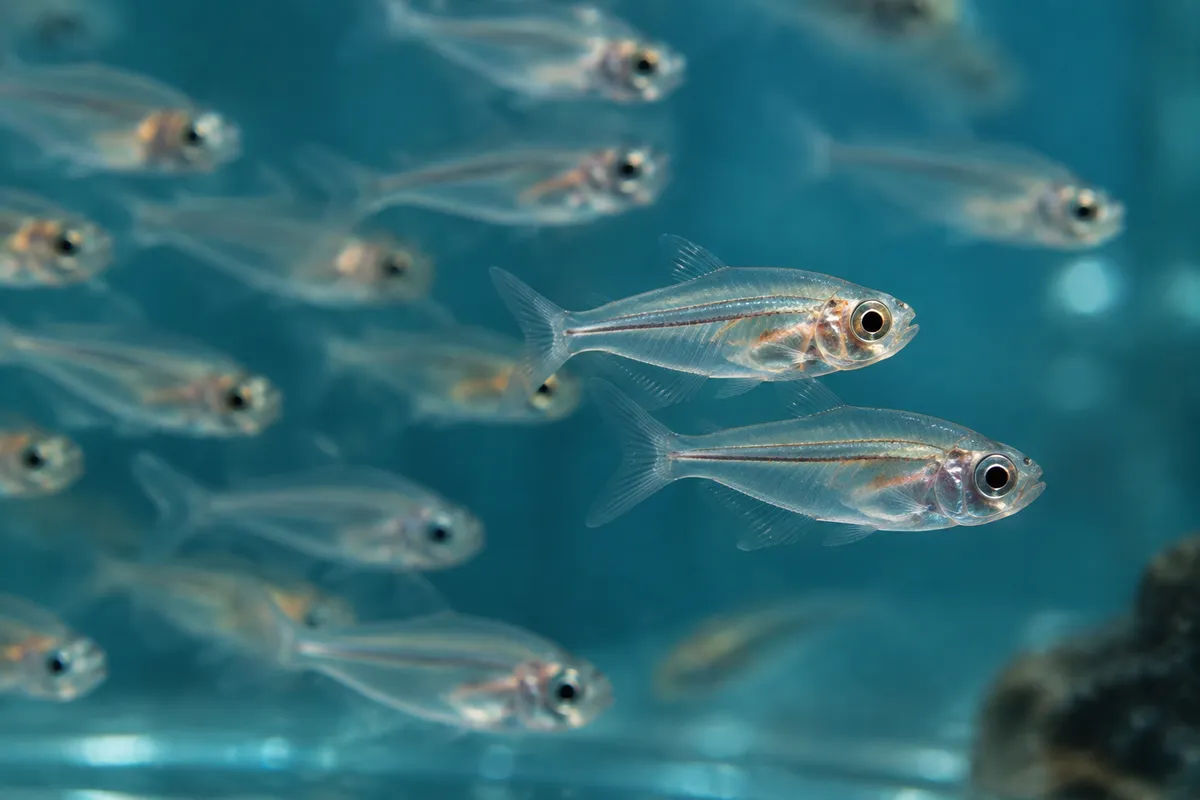
A school of fish turns in a flash, thousands of bodies shifting as if one mind steered them. You might assume each fish tracks the whole crowd and works out an average heading. Researchers at UC San Diego report something simpler: tiny glassfish seem to copy just one nearby neighbor at a time, in split-second decisions. By the end of this piece, you'll understand that rule, how virtual reality was used to test it, and why it matters beyond fish.
What the researchers found
Per Phys, which originally reported the study, the team looked at micro glassfish schools and found that group coordination appears to form through pairwise "copying." A fish responds to one nearby neighbor, then another, rather than averaging the movements of the entire group.
People have long been fascinated by flocking birds, swarming insects and schooling fish. Scientists have studied these displays to understand how coordination arises. This work points to an answer that is almost surprisingly modest: the group-level pattern comes from individual perception and brain processing, not from each animal tracking everyone.
The rule: one fish, one neighbor, one split-second decision
Think of it like a crowd doing the wave at a stadium. You don't calculate what thousands of people are doing. You watch the person next to you and move when they do. Repeat that across a crowd and a large pattern emerges.
That comparison is mine, not the researchers', but it captures the idea. In the glassfish model, each fish attends to a single neighbor at a given moment and copies that neighbor. Chain enough of those quick copies together and the school looks unified.
How virtual reality tested the idea
A model is only a guess until you test it. According to Phys, the researchers used virtual reality to check whether real fish behave the way the pairwise-copying model predicts.
VR lets scientists control what a fish sees. Instead of waiting for natural interactions in a messy school, they can present virtual neighbors and watch how the real animal responds. The report says the fish reacted to those virtual neighbors in ways the pairwise-copying model predicted.
That is the key result. The model didn't just describe recorded schools after the fact; it anticipated how live fish would respond to controlled stimuli.
Why glassfish are a good subject
Glassfish are transparent. Per the summary of the study, that makes them useful for exploring how tiny brains produce complex group behavior in real time. Seeing through the animal opens the possibility of linking what a fish perceives to what its brain is doing, and from there to how the group moves.
The researchers' framing connects three levels that are usually studied separately: what an individual perceives, how its brain processes it, and what the whole school does.
What this changes about "following the crowd"
The study reframes collective behavior. If a school's coordination comes from many small one-to-one interactions, then understanding the crowd means understanding the individual's perception, not computing a group average.
Phys notes the work reaches toward broader social coordination. I'd add a caution: fish are not people, and the report describes glassfish, not humans. Still, it's a useful prompt to ask how much of any crowd's behavior comes from local influence, one neighbor at a time, rather than awareness of the whole.
Takeaways you can use
- Simple rules can build complex patterns. One neighbor, copied quickly, can scale into a school that moves as one.
- Watch your own neighbors. The next time you're in a moving crowd, notice who you're actually tracking. Likely it's a person or two nearby, not everyone.
- Look for VR in animal research. Controlled virtual stimuli let scientists test ideas that natural settings make hard to isolate.
The next time you see a school flash and turn, remember it may not be a hive mind at all. It may be thousands of small decisions, each one a fish glancing at the fish beside it.