Japan has launched a spacecraft toward Mars, but its real destination is the red planet's moons. By the end of this article, you'll know what the MMX mission is trying to do, why a small moon like Phobos is worth the trip, and what to watch for over the next five years.
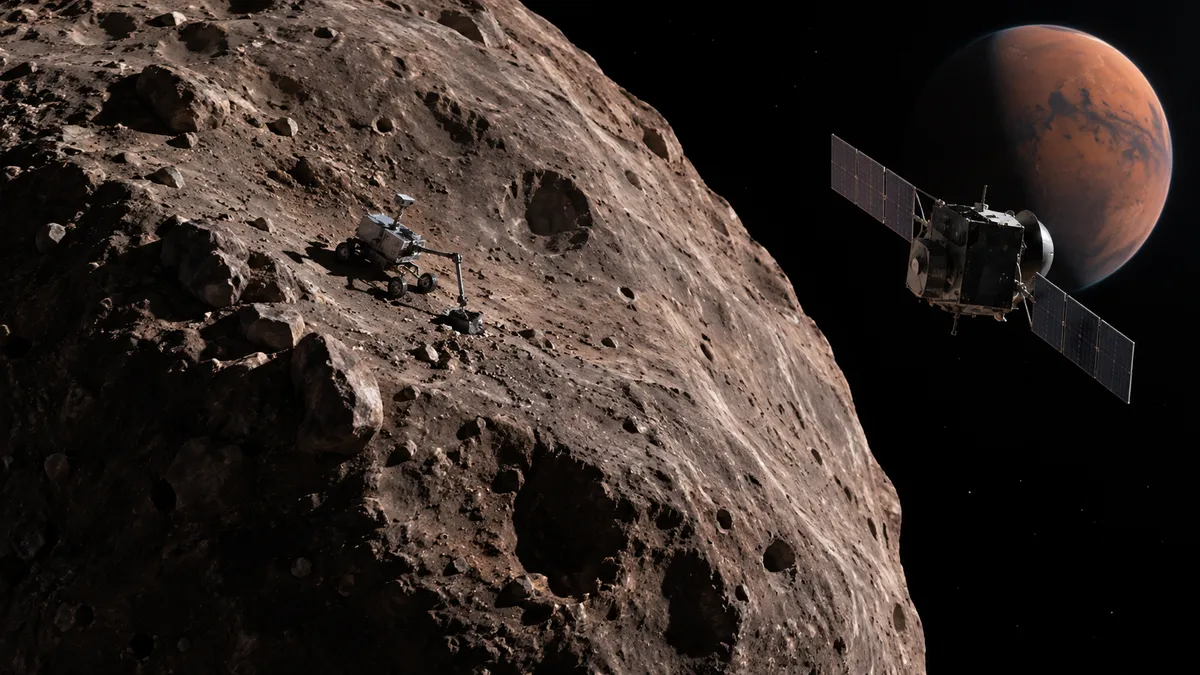
Per HuffPost, the five-year mission will attempt to land a robotic prospector and a rover on Phobos, the larger and closer of Mars' two pint-sized moons. The spacecraft will also explore Deimos, the other moon, and aims to return samples from Phobos to Earth by 2031.
The one-sentence version of the mission
MMX is going to Mars' moons, landing on Phobos, and bringing a piece of it home. According to HuffPost, it is the first attempt to bring back material from the Martian system.
That last point is the headline. Samples from the Martian system have never made it to Earth, and the mission puts Japan at the center of what HuffPost describes as a new space race alongside China and NASA.
Why a tiny moon could answer big questions
Phobos and Deimos are small, and nobody has settled how they came to be. The mission could reveal how Mars' moons formed, per the report. A physical sample is the kind of evidence that can narrow that question down in ways distant observation can't.
The report also says the findings could provide clues for future Mars exploration. That's the broader appeal: a moon is a nearby, low-gravity body that tells you about the planet it orbits.
What a sample can do that a telescope can't
This is my analysis rather than something from the report: a sample sitting in a lab on Earth can be tested again and again, with new instruments, by many teams, for years. A one-time measurement from a spacecraft can't offer that. It's the reason sample return missions are such a big deal.
Why Phobos is a hard place to land
Phobos is lumpy and tiny, and its gravity is weak. The report highlights a small rover named Idefix as part of the mission, and the gravity challenge is a key reason landing there is considered bold. I can't tell you more about Idefix's design or how it will move from the information published so far, so treat the details as something to watch as the mission unfolds.
In plain terms, landing on a body with such faint gravity is less like parking a car and more like docking with something. That's my framing, not the outlet's, but it explains why the mission is called ambitious.
A race with a cooperative side
HuffPost frames MMX as part of growing global competition around Mars science, with Japan, China and NASA all in the picture. It also notes that multiple agencies are contributing to the mission, so competition and cooperation are running side by side.
If you follow space news, that's a useful lens. Missions rarely belong to just one country anymore, even when one flag is on the rocket.
What to watch over the next five years
The timeline is long, so here is how to follow it without refreshing news feeds:
- The journey to Mars. The mission is five years in total, so expect quiet stretches.
- The Phobos landing. This is the riskiest-sounding step: the prospector and the rover touching down on a small, lumpy moon.
- The sample return. The target is 2031. Anything that slips is worth watching, because the return is the whole point.
- The science afterward. Once samples reach Earth, the question of how Mars' moons formed gets its first real physical evidence.
The takeaway
When you hear "Mars mission," don't only look at the planet. Bookmark MMX, check back at the landing and again around 2031, and watch for the answer to a simple question: where did Mars' moons come from?