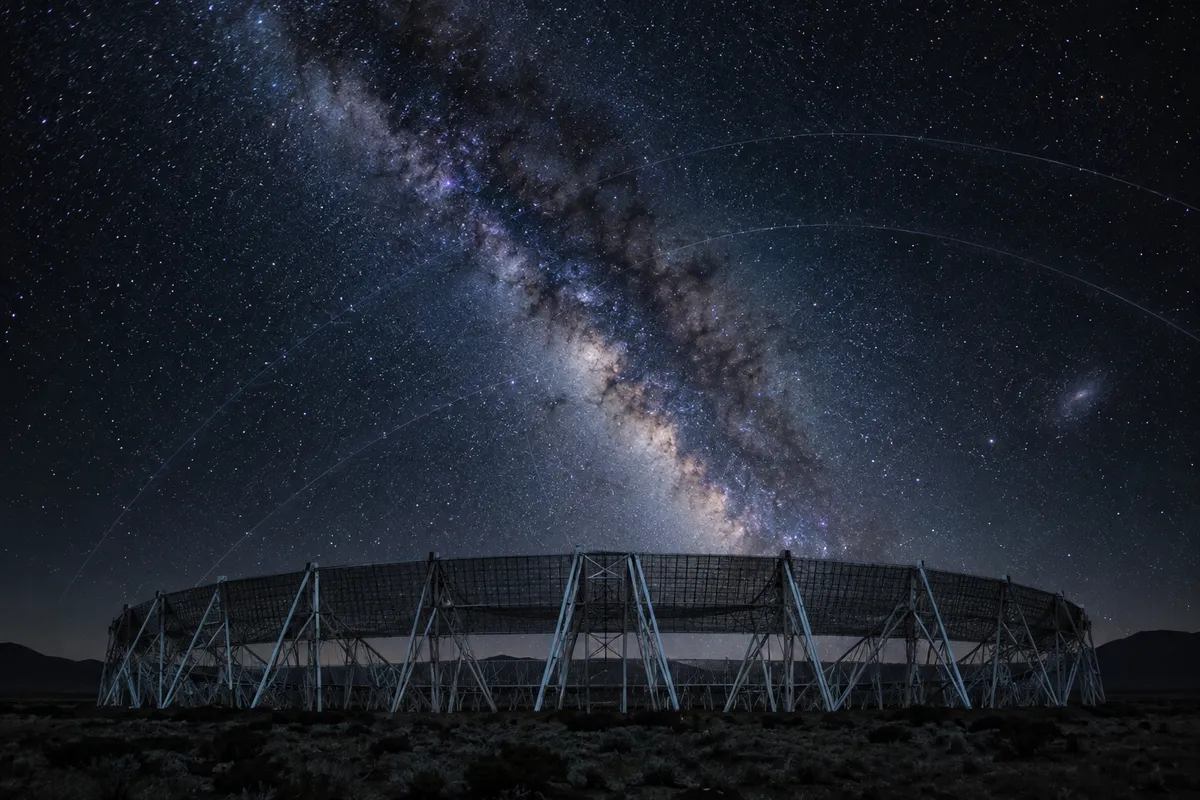
The Canadian Hydrogen Intensity Mapping Experiment, known as CHIME, has detected the faint radio glow of hydrogen gas from deep in the universe's past, and it did so using only its own data. Per Phys, that's a first. By the end of this article, you'll understand what that glow is, why it works as a map of cosmic history, and why a radio telescope might become a serious tool for studying dark energy.
What CHIME actually saw
Hydrogen is the most common element in the universe, and it gives off a very weak radio signal. CHIME picked up that signal from gas in the distant past, without needing to lean on outside datasets to confirm it.
That independence is the news. Earlier approaches to this kind of measurement needed help from other surveys. Showing that one instrument can find the signal on its own proves the technique works as a standalone method.
Why a faint glow works as a map
The technique is called hydrogen intensity mapping. Instead of picking out individual galaxies one at a time, it measures the combined glow of hydrogen gas across large patches of sky. Because hydrogen is spread through the universe wherever matter is, the brightness of that glow traces where matter sits.
Think of it like viewing a city at night from a plane. You don't need to identify every window to see where the dense neighborhoods are. The overall pattern of light tells you the layout.
Map that pattern at different distances, and you also map different moments in time, since looking farther away means looking further back. That's how a weak radio hum turns into a record of cosmic history.
Where dark energy comes in
Dark energy remains one of physics' biggest unresolved questions. It's the name given to whatever is driving the expansion of the universe. To test competing theories about how the universe evolves, cosmologists need to measure how matter has been distributed, and how that distribution has changed over time.
A hydrogen map gives them exactly that kind of measurement. The pattern of matter across cosmic time shows how expansion has unfolded, which is the information needed to check ideas about dark energy against each other.
The timing matters too. Cosmology is looking for independent ways to test those theories, and a method that doesn't rely on the traditional approach offers a useful cross-check.
Why this approach has an edge
According to the reporting, hydrogen intensity mapping can study cosmic expansion in three ways that traditional galaxy surveys struggle with:
- Farther back in time. It can reach earlier eras of the universe.
- At larger scale. It surveys big swaths of the sky at once rather than cataloging objects individually.
- At lower cost. It's a cheaper route than traditional galaxy surveys.
The cost point is worth sitting with. Big astronomy is usually expensive. A method that delivers large-scale maps for less could widen who can do this kind of science and how often.
The hard part: proving the signal is real
The signal is faint, and that's the challenge. A weak glow from the distant universe is easy to confuse with other sources of radio noise. Confirming a detection means showing, convincingly, that what you're seeing is hydrogen from deep in the past and not something else.
The fact that CHIME made the detection with only its own data is what gives the result weight. It shows the instrument and the analysis can stand on their own.
What comes next
CHIME now has nearly seven years of data available to expand this method. The detection is a proof of concept, and a larger dataset is the obvious next step for turning a first detection into a detailed map.
It's reasonable to expect that more data will sharpen what the technique can tell us, though the real test will be what the maps reveal about how the universe has expanded. That's my read, not a result reported by the team.
What to take from it
The next time you hear that dark energy is a mystery, remember that part of the answer may come from something far humbler than a giant optical survey: a radio telescope listening to the quiet glow of the most common element in the universe. Follow CHIME's progress as its nearly seven years of data get put to work.