Astronomers using the James Webb Space Telescope (JWST) may have spotted one of the earliest known cases of galaxies clearing the cosmic fog around them. By the end of this article, you'll understand what that means, why the early universe needed clearing at all, and why a cluster of just 18 galaxies is getting attention.
What astronomers found
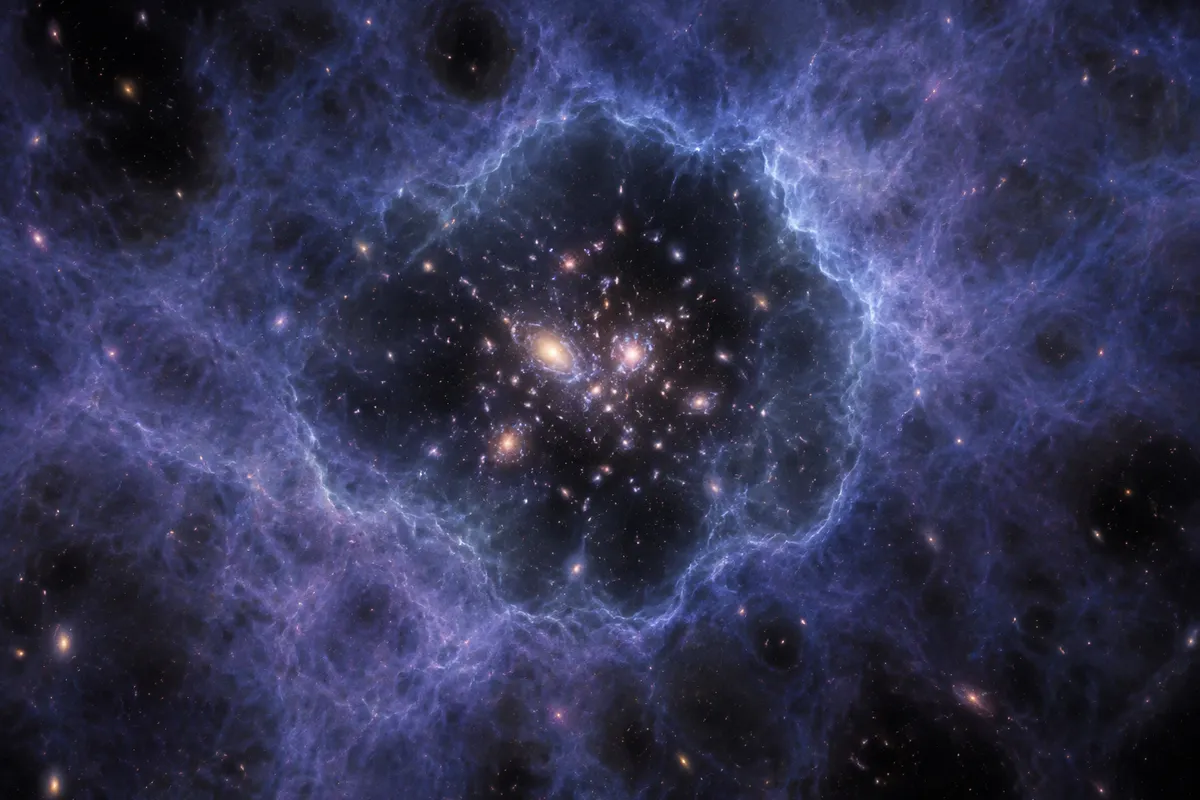
Per Phys, data from JWST's JADES survey reveals a dense group of 18 early galaxies, seen about 500 million years after the Big Bang. The group may be creating a large bubble of ionized hydrogen around itself.
If that interpretation holds up, it would be the earliest known ionized bubble produced by a galaxy overdensity. It could also offer some of the earliest evidence for how cosmic reionization began.
The fog problem: why the early universe wasn't transparent
Picture the young universe as a room full of fog. Hydrogen gas filled space, and neutral hydrogen is good at absorbing and scattering certain kinds of light. Light from early objects struggled to travel far through it.
Cosmic reionization is the transition that changed this. Energetic light from early galaxies stripped electrons from hydrogen atoms, which is what "ionized" means. As that happened, the universe became transparent to light.
A handy way to hold the idea in your head: each galaxy acts like a lamp burning a hole in the fog. Enough lamps close together, and the holes merge into something much bigger.
What an ionized bubble is, and why it matters
An ionized bubble is a region of space where the surrounding hydrogen has been ionized by the light of nearby galaxies. Inside it, light can travel more freely than in the neutral gas outside.
That's why a dense group of galaxies is interesting. Galaxies packed close together can combine their output, which makes it plausible that together they clear a bigger region than any one galaxy could alone. The finding suggests a possible mechanism for how reionization got started: not evenly everywhere, but in patches around crowded neighborhoods.
That last point is my reading of the result rather than a claim from the report, and the finding still needs confirmation.
The Lyman-alpha clue
One of the puzzles in this area is Lyman-alpha light, a signature emission from hydrogen that astronomers use to study distant galaxies. Whether that light can escape from the early universe depends on how much neutral hydrogen lies in its path. Seeing it escape from a galaxy group is a hint that the surrounding fog has thinned out.
The summary of the Phys report highlights this escape of Lyman-alpha light as part of the mystery surrounding the finding. I can't report further details of the measurements here, so treat this as the conceptual connection: light getting out suggests a clearer path.
Why JWST keeps surprising cosmologists
JWST continues to rewrite the timeline of early galaxy formation, per the report. Galaxies appear to have been busy earlier than many expected, and this result adds a possible answer to one of cosmology's biggest transitions: how the universe went from murky to clear.
The key word is "may." The bubble interpretation is a possible explanation, and the claim of an earliest-known bubble applies only if it's confirmed. Expect follow-up observations and debate before anyone calls it settled.
How to think about it
- Fog to clarity: reionization is the universe becoming transparent.
- Lamps in the fog: galaxies ionize hydrogen around them.
- Neighborhoods matter: a dense group of 18 galaxies may clear a larger bubble than isolated ones.
- Timing: this group is seen about 500 million years after the Big Bang.
The takeaway
Next time you see a JWST image of tiny, faint early galaxies, look at them as light sources doing a job: slowly clearing the fog so the rest of the universe could be seen. Follow the confirmation work on this galaxy group, because it could show where that story began.