BuzzFeed Shopping recently published a roundup of 29 kitchen products, each pitched as a fix for a specific everyday frustration. Its headline is refreshingly honest: the post won't solve all your kitchen problems, but 29 products can solve 29 of them. The source's own description is just as modest: "I'd be happy with 29 fewer problems."
I can't walk you through the individual products, because the details of the list aren't something I have in front of me. What I can give you is the idea underneath it, which is worth more than any single gadget: fix kitchen problems one at a time, and match the tool to the annoyance. Here is how to do that so you spend less and actually notice the difference.
Why the "one problem, one fix" approach works
BuzzFeed's roundup is built around a simple structure: name a common annoyance, then point to a product that addresses it. That structure is useful far beyond shopping lists. A vague goal like "organize my kitchen" is overwhelming. A specific complaint like "I can never find the lid that fits this pot" is solvable in an afternoon.
The roundup covers cooking, cleaning, storage, and organization frustrations, per BuzzFeed. Those four categories are a handy way to sort your own complaints.
Step 1: Keep a three-day annoyance log
Before buying anything, notice what bugs you. For three days, keep a note on your phone and jot down every moment of friction in the kitchen. Examples:
- You dig through a drawer to find one utensil.
- You wipe the same sticky spot on the counter every night.
- You can't reach what's at the back of a cabinet.
- Something takes five steps when it should take two.
Don't solve anything yet. You're collecting data. Patterns show up fast, and they usually point to two or three real problems rather than twenty.
Step 2: Sort complaints into the four buckets
Use the same categories the roundup does.
Cooking
These are annoyances that happen while food is being prepared: awkward prep, messy steps, tools that don't do their job well.
Cleaning
These are the tasks you put off. If you dread something, there is often a tool that shortens it, or a habit change that makes it unnecessary.
Storage
This is about where things live. If an item is hard to put away, it ends up on the counter.
Organization
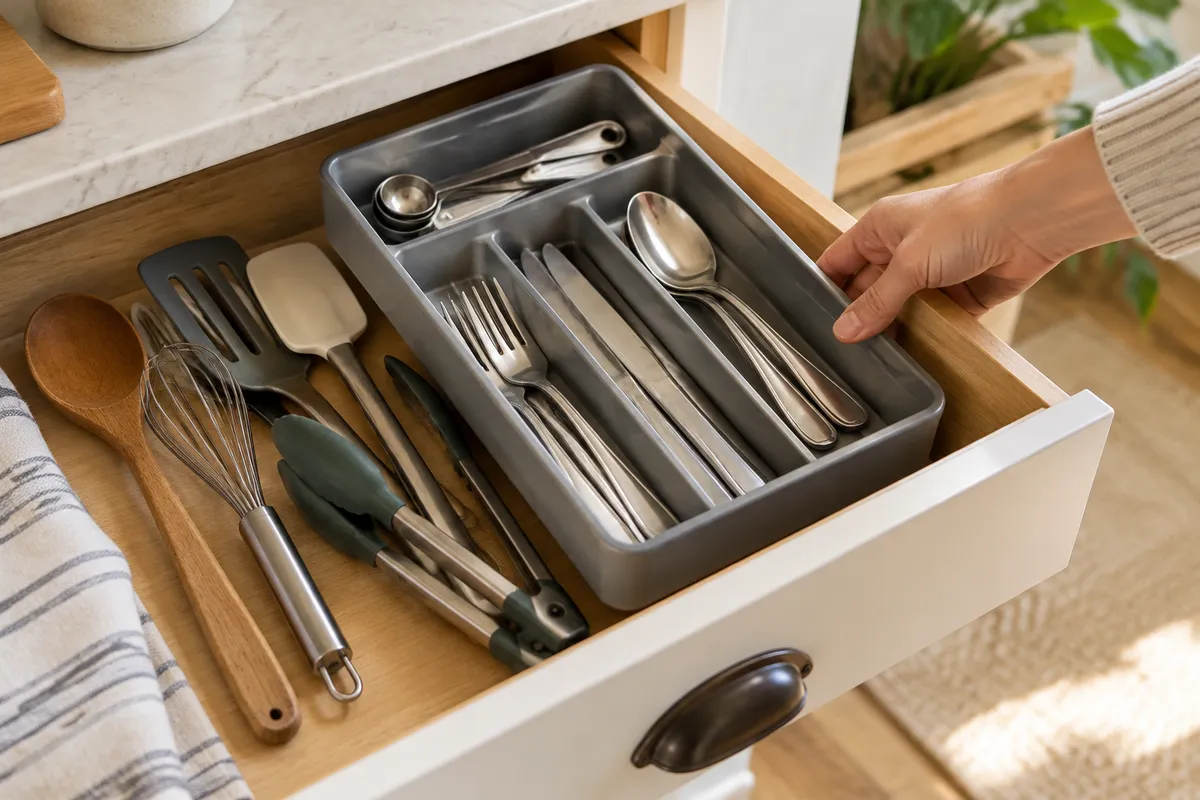
This is about finding things quickly. Contents of drawers and cabinets belong here.
Seeing which bucket holds most of your complaints tells you where a small purchase will matter most.
Step 3: Try a free fix before you buy
Buying is the last step, not the first. For each complaint, ask whether rearranging solves it. Move the things you use daily to the most reachable spot. Group items by task, such as baking tools together. Clear one shelf completely and put back only what earns its place.
If the annoyance survives that, it's a real candidate for a product.
Step 4: Buy for one problem, and set a limit
This is where a roundup like BuzzFeed's earns its keep. Product-led lists are useful for showing you what kinds of solutions exist, so you don't have to invent them from scratch. Use them as a menu, not a shopping cart.
Some practical rules:
- Pick one item per complaint. If you have a storage problem, buy one storage solution, not a matching set.
- Measure first. Small-space organization fails most often because something doesn't fit. Write down the width, depth, and height of the space.
- Set a budget per fix. Decide the number before you browse. Small upgrades are the point.
- Wait a day. If you still want it tomorrow, it's probably solving something real.
Step 5: Test it for a week
After you buy, check your annoyance log. Did the specific friction go away? If yes, keep it. If you haven't used it after a week or two, return it if the store allows, or pass it along. A gadget that sits in a drawer is just a new kind of clutter.
A before-and-after photo of the problem spot helps. It's also how the roundup's format tends to work well for readers: a visible problem and a visible fix make the benefit easy to judge.
What a list of 29 can and can't do
It's easy to read a roundup like this and feel you need all of it. You don't. The headline itself is the better guide: no single post, and no single product, fixes the whole kitchen. Each item fixes one thing, and only if that thing is a problem for you.
The things that make cooking feel less chaotic are usually small, cheap, and specific. That's good news, because it means you can improve your kitchen this week without a remodel.
Your next move
Start the annoyance log tonight. In three days, pick the one complaint that bothers you most, try a free rearrangement, and only then go shopping for a single fix. If you want ideas for what's out there, BuzzFeed's 29-product roundup is a good place to browse, with your list in hand.