A video making the rounds claims to show unknown creatures filmed in and around Yellowstone National Park. It covers three alleged sightings: dark figures on a live camera, a blurry trail camera image in Montana, and a legend of something serpent-like in Yellowstone Lake. You can't settle any of them from your couch. You can, though, learn a method for judging this kind of footage, and use it on the next "caught on camera" clip you see.
Here are the three cases as the video presents them, and the questions worth asking about each.
Case 1: Upright figures on a Yellowstone live camera
The first item involves what the video describes as mysterious humanoids captured on a Yellowstone live camera. According to the video, the footage allegedly shows upright dark figures near bison. Some viewers read them as Bigfoot.
What to ask
- How far away is the subject? Live cameras often sit at long range. Distance flattens detail and makes it hard to judge size, shape, or posture.
- What else is in frame? Bison are large, dark, and can look very different depending on angle and light. A shape beside a bison tells you little without a clear sense of scale.
- Could it be people? The park is one of the most visited in the country. A distant person in dark clothing is a far more common sight than an unknown primate.
- Is there more than one clip? One ambiguous moment is a curiosity. Repeated, clear footage from different angles would be evidence.
The conventional explanations the video itself acknowledges are wildlife, distance distortion, and people. Those are not boring dismissals. They are the most statistically likely answers, which is why they come first.
Case 2: A blurred trail camera image near Gardiner/Jardine, Montana
The second item is a trail camera image from the Gardiner/Jardine area of Montana, near the park. The video says it shows a blurred creature that some compare to Bigfoot.
Why trail cam images fool people
Trail cameras fire on motion, often at night with infrared, and often catch an animal mid-movement. That produces a few predictable quirks:
- Motion blur smears limbs and can make a four-legged animal look upright.
- Close-to-lens effects make something near the camera look huge or oddly proportioned.
- Infrared washout bleaches fur and erases the details you'd use to identify a species.
A bear rearing up, or standing on hind legs at an odd angle, is a classic candidate. The video notes bears among the conventional explanations. The useful question is not "does it look like Bigfoot?" but "does it look like a bear that moved?" A blur can support both stories, so it settles neither.
Case 3: The creature said to live in Yellowstone Lake
The third item is different in kind. It is a legend rather than a single piece of footage: the video points to long-standing stories of giant serpent-like beings in Yellowstone Lake.
This one is hardest to test, because there is no clip to freeze-frame. What you can do is consider what a lake like this offers storytellers and observers. Based on the explanations the video raises, likely contributors include:
- Floating or partly submerged logs, which can move with wind and current and look like a body breaking the surface.
- Geothermal activity, which can disturb water, create unusual surface patterns, and add to the sense that the place is not quite ordinary.
The video also frames these stories as legends with deep roots. It's worth treating that history with respect rather than as a punchline, and checking primary sources on Indigenous stories rather than relying on a short video's summary. I can't tell you from the video what any particular tradition says, and you shouldn't take a viral clip's word for it either.
Why Yellowstone keeps producing these stories
The video's main argument is that the park's vast wilderness and long history of reports make these mysteries hard to dismiss completely. That's fair as far as it goes. Remote terrain means big stretches of land that few people see, and gaps in what we see are where stories grow.
But here's my own take, and it's clearly mine: a big, wild place explains why people tell these stories, not why the stories are true. Two things are both real. The park really is huge and hard to monitor. And the easiest explanations for odd footage, such as animals, people, logs, and steam, are available in almost every frame.
There's also a simple draw. Yellowstone is a recognizable name with a built-in audience, so a mystery set there travels farther than the same blurry image from an anonymous patch of forest.
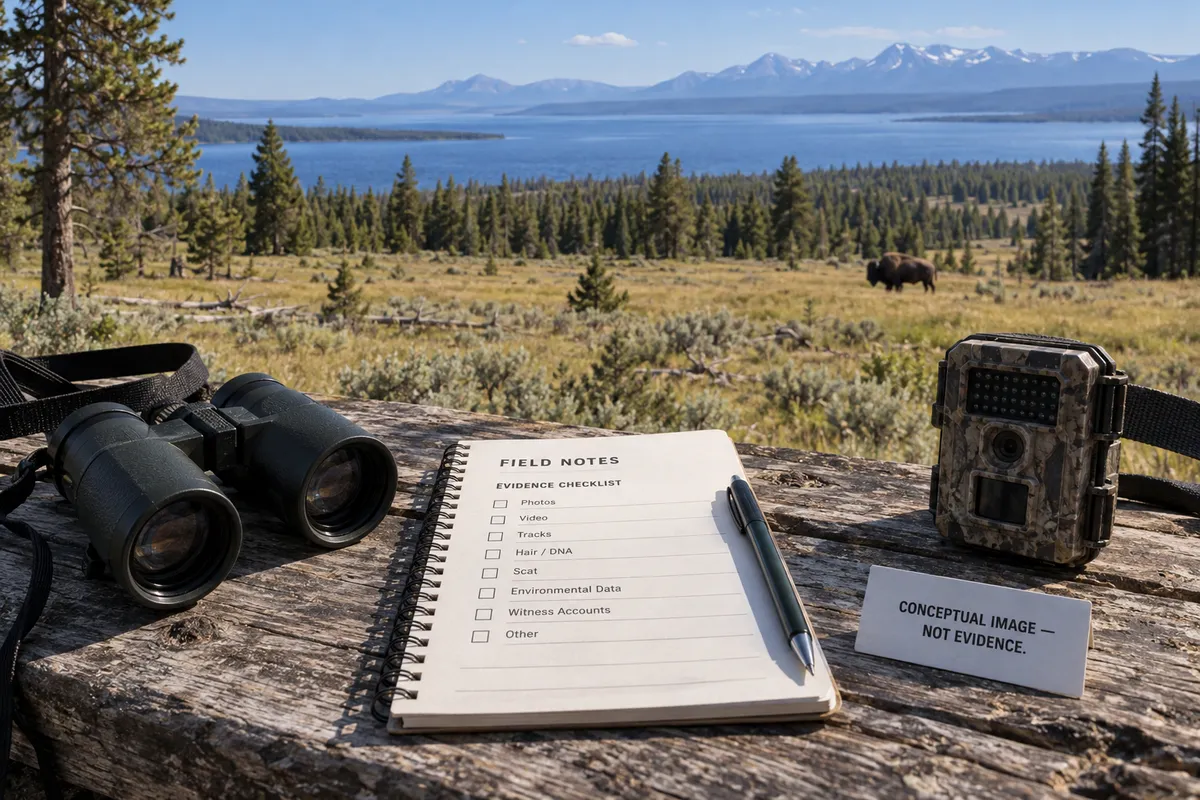
A quick checklist for any "unknown creature" clip
Use these five checks before you share the next one:
- Find the original source. Who first posted it, and when? Reposts often strip context.
- Look for scale. Is there a tree, a vehicle, or an animal of known size next to the subject?
- Run the boring list first. Bear, bison, person, log, steam, shadow. Can any of them fit?
- Check the camera. Distance, night mode, and motion blur all distort shape.
- Look for repeats. One unclear frame is a story. Multiple clear, independent recordings are a lead.
If you're visiting the park
If these sightings make you want to go, treat the real animals with the seriousness they deserve. Bison and bears are the creatures you are actually likely to meet, and they are genuinely worth watching from a safe distance. Bring binoculars, which will do more for your wildlife viewing than any mystery will. And if you spot something that doesn't fit, note the time, place, and distance, and take steady footage rather than a quick shaky clip.
The best response to a Yellowstone monster video isn't belief or scorn. It's curiosity with a checklist: look closely, name the likeliest explanation, and stay open to the day the footage is clear enough to change your mind.